Source Office Desk Options for Hotels, Homes, and Offices
Find and compare 30 office desk listings featuring modern, industrial, and adjustable designs. Evaluate materials like wood and metal, check specifications such as size and drawer configurations, and review pricing details for commercial and residential procurement needs.
Key considerations
Products List




Comprehensive Sourcing Guide
Office Desk Sourcing Guide
Selecting the right office desk requires balancing aesthetic alignment with functional durability, particularly when sourcing from international markets. The current market landscape offers a diverse array of options, ranging from traditional wooden PC desks to modern, height-adjustable steel workstations. Buyers must navigate this variety by focusing on specific material properties, structural specifications, and intended usage environments. Whether the requirement is for a compact home office setup or a large-scale corporate fit-out, the decision hinges on verifying that the product’s physical attributes match the operational demands of the workspace.
Procurement success depends on rigorous verification of supplier claims against observable listing signals. The available data indicates a wide spectrum of product types, including models identified by codes such as C-129 and CX-183, as well as specific model numbers like Hy_TM9099. These identifiers are crucial for tracking inventory and ensuring consistency across bulk orders. Furthermore, the presence of customization options and varied design styles, from modern to industrial, suggests that buyers should not assume a one-size-fits-all approach. Instead, they must define their exact needs regarding dimensions, storage configurations, and material composition before engaging with suppliers.
Product Scope and Observed Listing Signals
The observed product range spans multiple material categories, primarily wood and metal, each serving distinct aesthetic and functional purposes. Wooden desks, often described with a panel wood style, are frequently marketed for use in living rooms, bedrooms, and study areas, offering a warmer, traditional aesthetic suitable for residential or executive office settings. In contrast, metal-based desks, such as those described as steel office desks with an industrial design and silver color, are positioned for commercial furniture applications, including offices, schools, and hospitals. This material divergence requires buyers to assess the environmental context of the installation, as metal desks may offer greater durability and a modern look, while wooden desks provide a classic finish.
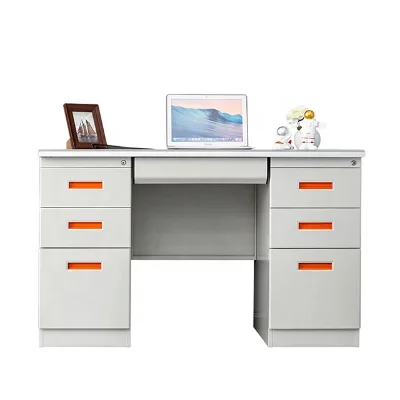
Usage scenarios further differentiate the product scope, with listings indicating suitability for a broad array of environments including hotels, apartments, warehouses, and sports venues. Some products are explicitly labeled as healthy office furniture with adjustable height features, catering to ergonomic needs in home offices and corporate workspaces. Other models are designed as specific computer workstations or executive tables, emphasizing storage capabilities with configurations ranging from one drawer and one door to five-drawer setups in various thicknesses. Buyers must carefully match these specific use cases and storage requirements to their operational needs, ensuring that the selected desk supports the intended workflow and spatial constraints.
Technical Specifications to Verify
Dimensional accuracy is a critical factor in office desk procurement, as listed specifications vary significantly across different models. For instance, one observed standard specifies a size of 800500MM, while another lists dimensions of 12054*76cm, highlighting the need for precise measurement verification. Buyers should confirm whether the listed dimensions refer to the desktop surface, the overall footprint, or the height, particularly for adjustable models. The availability of specific size options, such as 1.2m and 1.4m widths, along with thickened variants, suggests that structural integrity and load-bearing capacity may vary. It is essential to verify these measurements against the available floor space and ergonomic requirements to ensure a proper fit.
Storage and configuration details also require close attention, as models differ in their drawer and door arrangements. Options include one-drawer one-door configurations, four-drawer setups, and five-drawer variations, some of which include empty spaces for specific organizational needs. The distinction between standard and thickened versions may impact the desk’s durability and aesthetic appeal. Additionally, buyers should verify the packing details, such as the volume of 0.089cbm for certain models and the packing method of one piece per carton, to calculate shipping costs and storage requirements accurately. Understanding these technical nuances helps in avoiding discrepancies between the ordered product and the delivered item.
Compliance and Safety Documentation
While specific certification statuses are not explicitly detailed in the provided facts, buyers must ensure that all office desks comply with relevant safety and quality standards for the destination market. This includes verifying that materials used, whether wood or metal, meet environmental and health regulations, particularly for products intended for schools, hospitals, and children’s areas. Buyers should request documentation confirming that the furniture is free from harmful substances and that the finishes are durable and non-toxic. Given the diverse applications, from residential to commercial, adherence to local building codes and furniture safety standards is paramount to mitigate liability and ensure user safety.
Documentation should also cover the structural integrity and stability of the desks, especially for adjustable height models and those with extensive storage configurations. Buyers should inquire about test results related to load-bearing capacity, stability under movement, and the durability of moving parts such as height-adjustment mechanisms. For wooden desks, verifying the quality of the panel wood and the stability of the joints is crucial. For metal desks, checking the finish quality and resistance to corrosion is important. Ensuring that suppliers provide comprehensive safety documentation helps in maintaining a safe working environment and complying with regulatory requirements.
Cost Drivers and Commercial Terms
Several factors influence the cost of office desks, including material choice, customization options, and order volume. The observed MOQ range of 1 to 50 pieces indicates flexibility for both small and large orders, but buyers should be aware that customization may incur additional costs. Models with specific features, such as adjustable heights or unique storage configurations, may be priced higher than standard designs. Additionally, the supply ability of 1000 cartons per month for certain suppliers suggests that larger orders may benefit from economies of scale, potentially reducing the per-unit cost. Buyers should negotiate based on their specific volume requirements and desired customization level.
Payment terms and delivery timelines are also significant commercial considerations. The observed payment methods include T/T or L/C, which are standard for international trade, but buyers should clarify the deposit requirements and balance payment conditions. The delivery date of 30-35 days for some models indicates a moderate lead time, which should be factored into project planning. Buyers should also consider the port of dispatch, such as Ningbo or Shanghai, as this may affect shipping costs and transit times. Understanding these commercial terms helps in budgeting accurately and managing expectations regarding the procurement timeline.
Supplier Qualification and Quality Control
Verifying the supplier’s origin and production capabilities is essential for ensuring product quality and reliability. The observed origins include China, with specific provinces like Hebei, Jilin, and Guangdong mentioned, indicating a diverse manufacturing base. Buyers should assess the supplier’s experience and reputation in producing office furniture, particularly for the specific types of desks they are sourcing. Requesting samples before placing bulk orders is a prudent step to evaluate the build quality, finish, and functionality of the desks. This allows buyers to identify any potential issues with materials or construction before committing to a large purchase.
Quality control processes should be clearly defined and agreed upon with the supplier. This includes inspections during production and before shipment to ensure that the products meet the specified standards and specifications. Buyers should inquire about the supplier’s quality assurance protocols, including how they handle defects and returns. For customized orders, it is crucial to have clear specifications and approval processes in place to avoid misunderstandings. Establishing a strong relationship with the supplier and maintaining open communication can help in resolving any issues that may arise during the procurement process.
Long-Term Procurement Checks
Sustainability and after-sales support are key considerations for long-term procurement success. Buyers should inquire about the supplier’s practices regarding sustainable sourcing of materials, particularly for wooden desks, to ensure environmental responsibility. Additionally, understanding the warranty terms and after-sales support provided by the supplier is crucial for addressing any issues that may arise post-delivery. This includes the availability of replacement parts, repair services, and customer support. A supplier with a robust after-sales support system can help in maintaining the longevity and functionality of the office desks.
Regular review of supplier performance and product quality is also important for maintaining a reliable supply chain. Buyers should track metrics such as delivery times, product defect rates, and customer satisfaction to evaluate the supplier’s consistency. This data can be used to negotiate better terms and identify areas for improvement. By continuously monitoring these factors, buyers can ensure that their office desk procurement remains efficient, cost-effective, and aligned with their organizational needs over time.
FAQs
What materials are used for these office desks?
The desks are constructed from wood and metal materials. Some models feature a panel wood style while others utilize steel frames. This combination ensures durability for various commercial and residential environments.
Can I customize the size of the office desk?
Yes, customization is available for these office desks. Buyers can request specific dimensions such as 800*500MM or 120*54*76cm. The product listings confirm that custom options are supported for various needs.
What is the minimum order quantity for these desks?
The minimum order quantity varies by supplier but can be as low as one piece. Some listings specify an MOQ of five pieces. Buyers should verify the specific requirement for their chosen model before placing an order.
How long does it take to deliver the office desks?
The delivery date typically ranges from 30 to 35 days after order confirmation. This lead time applies to standard production cycles. Buyers should account for this duration when planning their procurement schedules.
Where are these office desks manufactured?
These desks originate from China, specifically from provinces like Hebei, Jilin, and Guangdong. The products are shipped from ports such as Ningbo and Shanghai. This location data helps in estimating shipping costs and times.
What styles are available for the office desks?
The desks come in modern and industrial design styles. They are suitable for various settings including hotels, offices, and homes. The modern style is the most frequently observed attribute across the product listings.